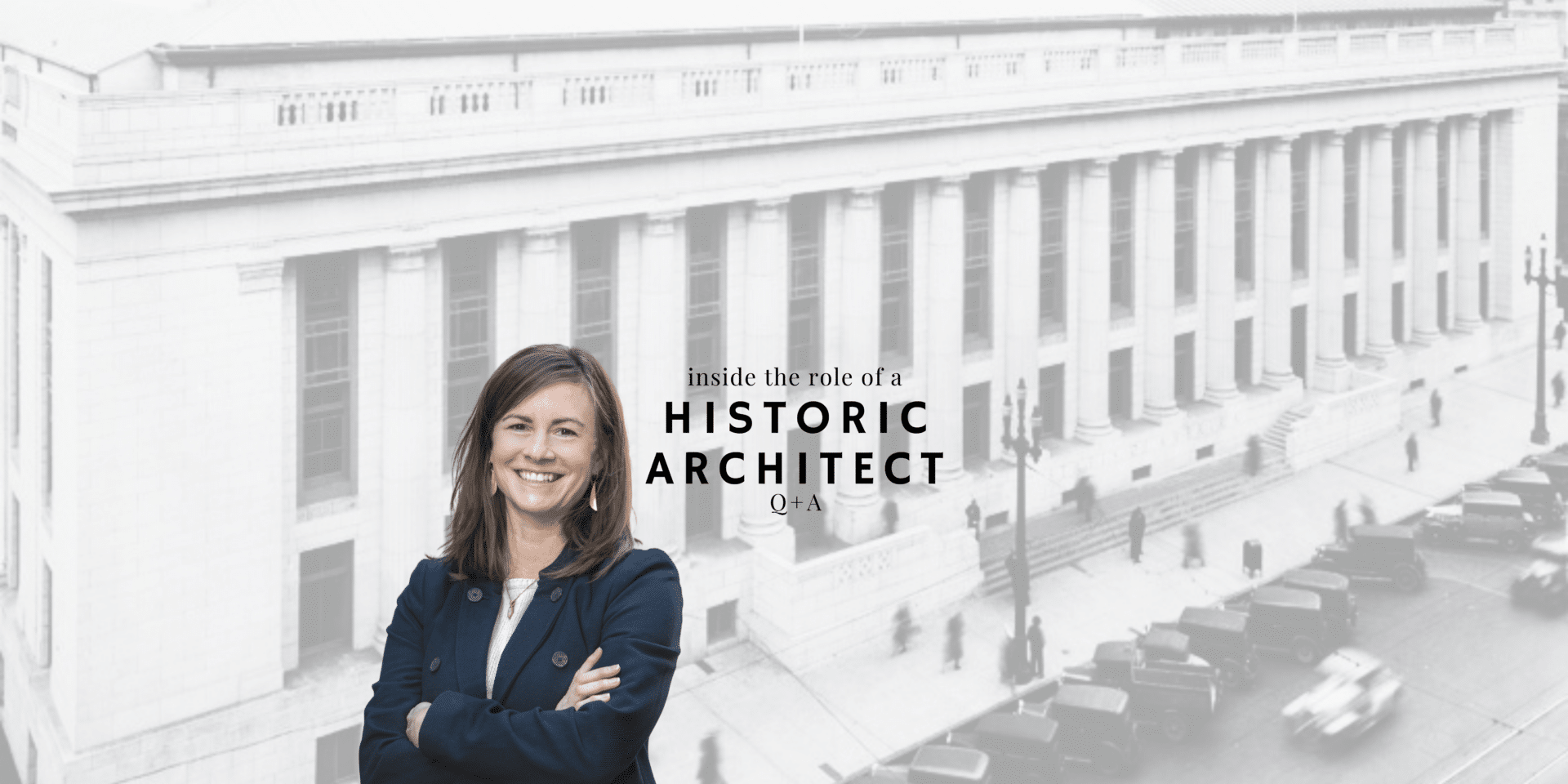
From century-old courthouses to evolving public spaces, historic properties present both opportunity and complexity. In addition to design skills, navigating these projects requires a deep understanding of preservation standards, regulatory processes and creative problem-solving.
In this Q&A, Trivers Principal Amy Gilbertson, FAIA, LEED Green Associate, shares insights on what historic architects do, how they collaborate with design teams and the value they bring to projects. Amy has dedicated her career to preserving and restoring some of the most storied buildings throughout the country, including 44 buildings on the National Register of Historic Places. She has served as a leader in the adaptive reuse and preservation of multiple federal, state and local buildings, garnering national recognition through numerous award-winning projects. Amy was elevated to the AIA’s College of Fellows in 2022 for her design work with historic structures.
Q: What is a historic architect?
A: A historic architect specializes in evaluating, preserving and restoring buildings with historical, cultural or architectural significance. They bring expertise in traditional materials and construction techniques, while ensuring projects meet regulatory requirements such as the U.S. Secretary of the Interior’s Standards for Rehabilitation. In a consulting role, they work alongside lead architects and clients to help modernize properties while protecting the features that define their character.
Q: What’s the difference between leading a project and consulting on one?
A: When Trivers leads a project, we’re responsible for setting the design vision and guiding it from concept through completion. In a consulting role, we support that vision, providing specialized expertise, technical input and strategic recommendations that help inform key decisions. Depending on the partner and project, we may be closely embedded with the design team or engaged at specific points to advise, but the lead architect ultimately directs and executes the work.
Q: What kinds of projects require a historic architect?
A: Historic architects are involved in a wide range of projects, from renovations and additions to new construction within historic buildings or sites. Even ground-up development on historically significant properties often triggers requirements such as Section 106 of the National Historic Preservation Act, which requires teams using federal funding to assess potential impacts on historic resources and consider public input.
For example, Trivers is leading the design of the first new buildings in Tower Grove Park in 50 years. To ensure the project complements the park’s historic character, the team is coordinating closely with the St. Louis Cultural Resources Office, the Missouri State Historic Preservation Office and other stakeholders—balancing preservation goals with the needs of a modern, evolving park.
Q: Why does Trivers choose to take on historic architect roles?
A: Consulting allows us to contribute to significant projects we might not otherwise have the opportunity to lead. We’d rather play a meaningful role on a complex, high-impact project than sit on the sidelines.
For example, on the terminal consolidation at St. Louis Lambert International Airport, Trivers is serving as historic architect alongside lead architect HOK. In that role, we’re helping the team navigate Section 106, evaluating potential impacts to the historic terminal and identifying ways to avoid, minimize or mitigate them. We’re also researching character-defining features so that the design aligns with the U.S. Secretary of the Interior’s Standards for Rehabilitation while accommodating modern needs.
Just as important, consulting gives us the chance to collaborate with firms we respect, exchange ideas and build relationships, which often leads to future opportunities.
Q: How has Trivers’ historic architect work grown over time?
A: Our historic architect work has expanded over the past decade as we’ve recognized the value of our expertise and the demand for it. We’ve taken on more projects involving federal requirements for historic review, and many of our partners, having worked with us in other capacities, have sought us out specifically for this capability. As a result, consulting has become an increasingly important part of our practice.
Q: What sets Trivers apart from other firms with historic architect capabilities?
A: Unlike some historic consultants, Trivers is a full-service design firm with capacity to serve as a lead architect. Because we regularly guide projects from concept through construction, we understand what design teams need both in terms of information and timing. That perspective allows us to deliver targeted, actionable guidance that keeps projects moving efficiently.
Our location in St. Louis is another advantage. The state’s long-standing historic tax credit program, which is widely regarded as a national model, has given us deep experience navigating complex preservation requirements and approval processes.
For example, on the Crunden-Martin Manufacturing Complex redevelopment in St. Louis, we served as historic architect in partnership with lead architect El Dorado. In that role, we led coordination with the Missouri State Historic Preservation Office, helping guide the project through federal and state historic tax credit approvals.
Q: What do you enjoy most about serving as historic architect?
A: Trivers enjoys the collaborative nature of the work, especially partnering with knowledgeable clients and design teams we respect. There’s also a real sense of satisfaction in helping teams navigate challenges. When something initially feels like it isn’t feasible, we’re often able to identify a path forward that balances modernization with preservation.
A recent example is the Frank E. Moss U.S. Courthouse project in Salt Lake City for the U.S. General Services Administration (GSA). As historic architect, Trivers worked alongside lead architect HOK on a complex seismic retrofit where the expectation was to mitigate adverse effects. Instead, through careful planning and creative solutions, the project earned a “No Adverse Effect” determination, which is the first of its kind for a GSA seismic retrofit. It’s now being looked to as a model for similar projects across the agency’s portfolio.
Q: What should a lead architect look for in a historic architect partner?
A: Look for a partner who understands how to navigate rigorous preservation standards while still finding creative, practical solutions for modernization. A strong historic architect doesn’t just protect what’s there; they help teams move a design forward.
Flexibility is also critical. Early in the design process, there are often multiple viable approaches, and approvals don’t always go exactly as planned. Experienced consultants anticipate that by helping secure alignment on more than one path forward, so projects can adapt without losing momentum.
Finally, strong communication and collaboration skills are essential. Historic architects often serve as a bridge between design teams, regulators and stakeholders, translating intent, building consensus and helping ensure projects are both approved and successfully executed.